All Categories
Featured

Why AI and Cloud Convergence Is Essential
Table of Contents
When considering enhancing consumer experiences, Pasquale DeMaio, VP of Amazon Connect, states to embrace systems that utilize AI and human strengths. "In customer assistance, agentic AI will manage routine demands while human representatives will resolve complex issues with compassion and subtlety, directed by AI insights and suggestions." CIOs ought to recognize a paradigm shift in UX, as information entry kinds, client journeys, and prescriptive reports get changed with agentic AI abilities.
"AI representatives will become the frontend of the business as the main beginning point for any and all external contact," says Antoine Nasr, head of AI at Planning. "End-users will no longer have to attempt and browse to the right department and tool to get the aid or details they require they will merely communicate with the company's public AI agent in natural language.
Abilities gaps in important areas like AI, artificial intelligence and cybersecurity now impact nearly 9 in 10 organizations, impacting not just IT but every function across the business. Digital tools like AI, low-code/no-code platforms and sophisticated analytics have ended up being embedded in day-to-day workflows, and all workers need to be geared up with the right abilities to drive efficiency and innovation.
Key Steps to Unlocking Full Digital Transformation
Resolving these widespread abilities spaces requires innovative, organization-wide talent strategiesenabling business to obtain and cultivate the know-how required to modernize their labor force and fully understand the benefits of digital change. The strategic release of digital innovations to improve and scale business procedures stays central to successful transformation efforts. Organizations are significantly concentrated on making info more accessiblenearly half are prioritizing digital tools that break down information silos and allow seamless gain access to across the business.
Together with these efforts, 46% of organizations are actively updating basic operating procedures to integrate brand-new digital technologies, making sure that procedures develop in step with innovation. Just about a quarter are focusing on modification management techniques as part of their transformation agenda. This restricted emphasis on modification management raises issues as it may leave organizations susceptible to worker resistance, misalignment and engagement challenges that can undermine digital efforts.
Comprehensive strategies, including senior management buy-in, clear communication, targeted training and stakeholder engagement, are essential for lining up groups with transformation goals and fostering a culture of flexibility and continuous enhancement. In 2026, innovation adoption continues to be a tactical motorist of digital improvement, with companies leveraging digital platforms to improve dexterity, scalability and development.
Optimizing Enterprise ROI Through Modern ModernizationKey Advantages of Enterprise Modernization in 2026
These technologies are not only commonly executed but likewise actively upgraded and fine-tuned by 17% to 18% of organizations, underscoring their central function in supporting seamless operations, hybrid work models and quick advancement cycles. Software application as a service (SaaS) and mobile web technologies reveal strong adoption, incorporated by 42% and 39% of companies, respectively, across several company systems.
With 17% of companies currently running pilots and 37% reporting adoption at scale, generative AI (Gen AI) stands apart as the most actively piloted technology in 2026. This signifies a shift from experimentation to operationalization as organizations look for to harness Gen AI for material creation, consumer engagement and automation of complex jobs.
Other innovations, such as huge data analytics (33% enterprise-wide adoption), automation technologies (31%) and basic AI (32%) are acquiring traction, supporting sophisticated analytics, procedure automation and data-driven decision-making. While interest in emerging innovations is growing, adoption remains measuredparticularly for augmented/virtual reality and blockchain, where 34% to 41% of companies report no plans for execution.
Not every company discovers instant value in embracing them due to the fact that their relevance and effect can differ significantly depending on sector needs and service models. For numerous, the decision to invest is driven by targeted chances instead of broad applicability, resulting in a more selective method to development. As digital transformation accelerates, organizations focus on innovations that provide short-term productivity gains and long-lasting scalability.
Essential Steps to Achieving Full Digital Transformation
Click here for an interactive look at this data, where you can drill down by the industry and geographic area.
The Core Benefits of Intelligent Cloud InfrastructureWhether enhancing customer experience or modernizing infrastructure, the best roadmap varies by organization and market. From logistics automation to virtual healthcare, improvement can drive both innovation and performance.
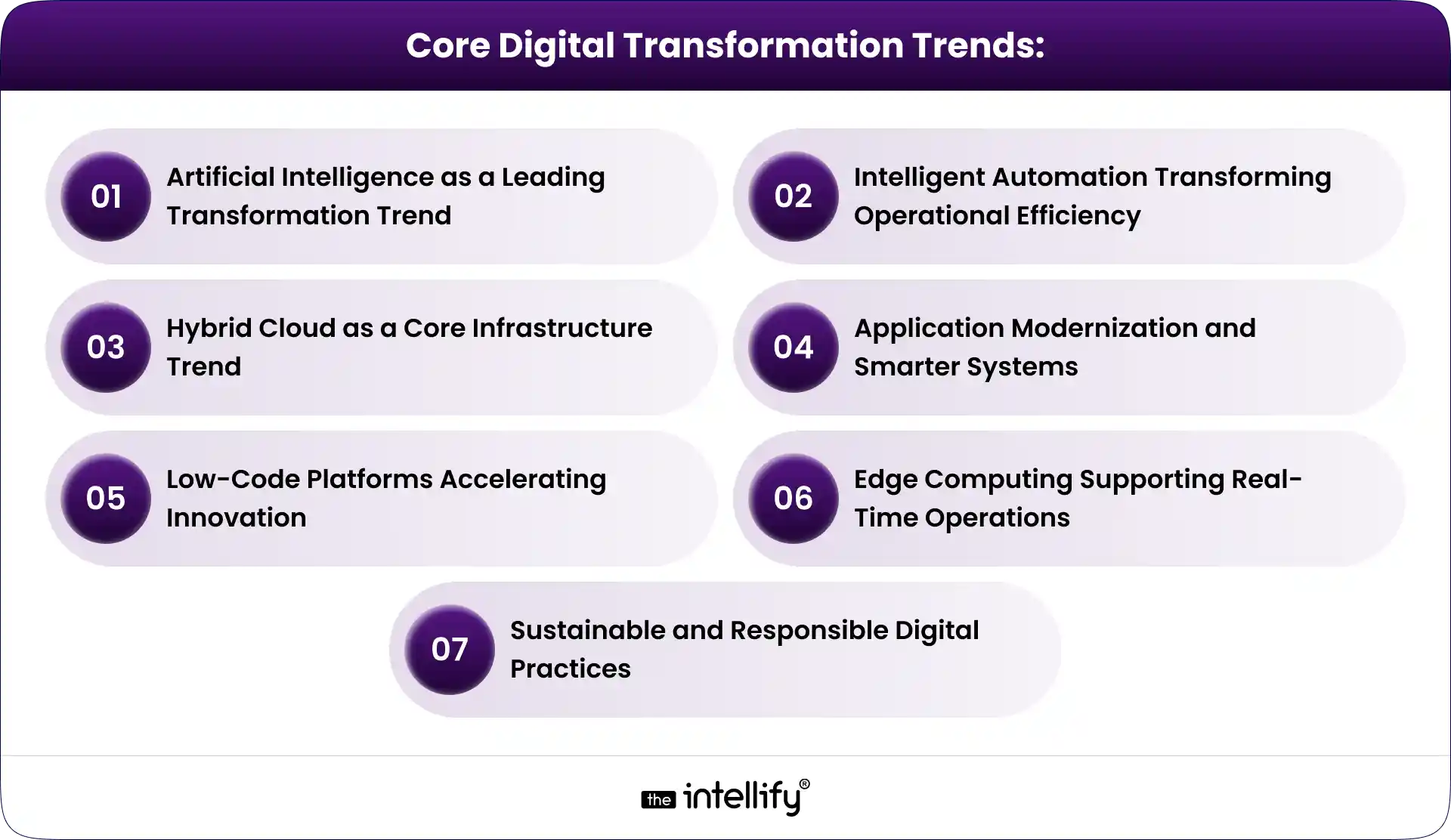
In this post, we'll explore how services are accepting digital change, where initiatives are focused, and why it stays a leading priority for companies seeking to remain competitive in a progressively busy, tech-driven world. Digital transformation involves using the current digital technologies to basically reshape how a company operates. While digital improvement ended up being a mainstream organization crucial in the 2010s, the roots go even more back, beginning with digitization in the 1980s and '90s.

Latest Posts

Is Your Enterprise Ready for AI Shift?
Actionable Tips for Successful Corporate Modernization
Transforming Data Infrastructure for the AI Age